





News & Updates
Latest Factory Trends, New Product Releases & Global Auto Parts Industry Insights
How Starter Motor OEM Suppliers Are Evaluated for Quality and Production Consistency
What really proves a starter motor OEM can hold quality steady?
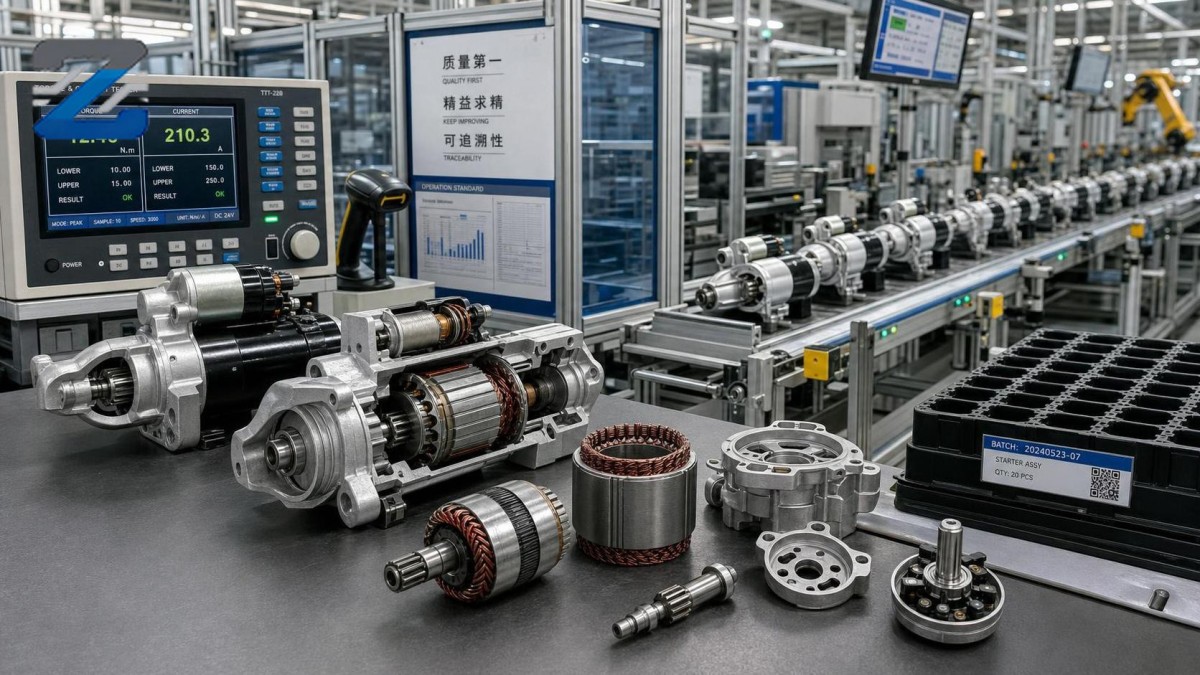
Price matters, but it does not reveal production discipline. A dependable starter motor OEM is judged by repeatability, traceability, and how well each batch performs under the same load conditions.
In practice, buyers look beyond samples. They check whether machining accuracy, winding stability, assembly control, and final testing remain consistent across large-volume orders.
This is especially important for construction machinery, tractors, and heavy-duty vehicles, where starting failure quickly becomes an equipment reliability and safety issue.
Which factory signals are more useful than a polished quotation?
A strong quotation can still hide unstable production. More useful signals come from the factory structure behind the part.
For a starter motor OEM, integrated processes usually matter. Die-casting, CNC processing, winding, and assembly under one production system make defect tracking faster and process variation easier to control.
Another practical sign is model maturity. When a supplier manages thousands of established starter motor models and stable annual output, process control is often more standardized.
- Clear incoming material inspection records
- Defined torque, current, and durability test standards
- Batch coding linked to components and operators
- Documented handling of nonconforming units
How do you compare suppliers without relying on broad claims?
A simple comparison table usually gives a clearer answer than marketing language. It helps separate process capability from surface-level presentation.
Where do production consistency problems usually start?
The weakest point is rarely the final assembly alone. More often, inconsistency begins earlier, with cast housings, shaft tolerance drift, coil winding variation, or uncontrolled supplier materials.
That is why a starter motor OEM should be reviewed as a manufacturing system, not just a finished-product source. A clean audit trail from raw material to end-of-line testing is more meaningful than a single successful sample.
It also helps to ask how process changes are managed. Even small tooling or component adjustments can affect engagement reliability and cold-start performance.
What documents and tests should be confirmed before approval?
The right documents depend on the application, but some checks are consistently useful when screening a starter motor OEM.
- Inspection standards for dimensions, insulation, and current draw
- Durability or life-cycle test reports for representative models
- Corrective action records for recent quality issues
- Production capacity data matched to lead time promises
Where applications are harsh, more attention should go to vibration resistance, thermal performance, and repeat-start behavior under load.
What is the practical next step when narrowing the supplier list?
Start with a controlled evaluation sheet. Compare process ownership, traceability depth, test records, and change-control discipline before comparing unit price.
A starter motor OEM with integrated production, mature model coverage, and stable export experience often offers fewer downstream surprises. That matters more than a low initial quote.
The most reliable decision usually comes from combining document review, sample validation, and a realistic check of batch consistency. That approach reduces quality risk and supports a steadier supply chain.