





News & Updates
Latest Factory Trends, New Product Releases & Global Auto Parts Industry Insights
Starter Motor Assembly Process Explained: Key Steps That Affect Reliability
Starter Motor Assembly Process Explained: Key Steps That Affect Reliability
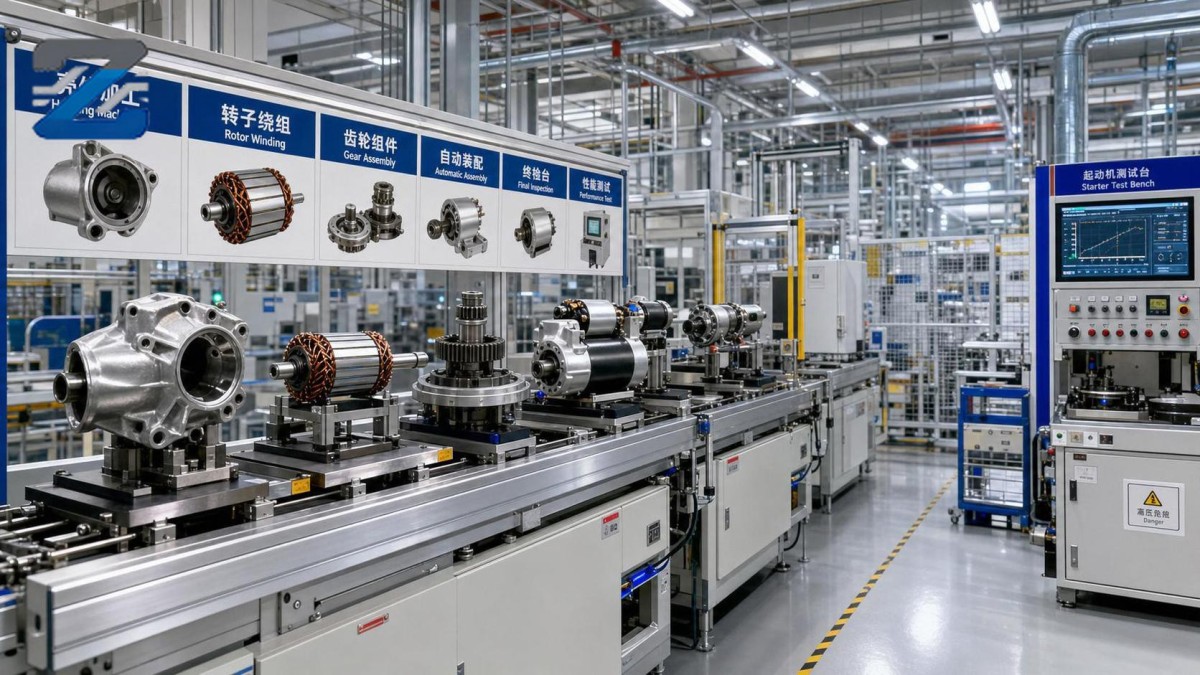
For technical evaluators, the starter motor assembly process reveals more than production flow. It shows how reliability, torque stability, and service life are actually built.
A well-controlled process reduces field failures. It also improves consistency across models used in tractors, construction equipment, and heavy-duty commercial vehicles.
In practice, small deviations during assembly often create the biggest long-term risks. That is why each step deserves close technical review.
1. Material Selection Sets the Reliability Baseline
The starter motor assembly process begins with materials. Housing strength, shaft hardness, copper purity, and insulation grade directly affect thermal resistance and wear behavior.
Poor raw materials can pass early inspection yet fail under repeated starts, vibration, dust, and high current load. This is a common reliability gap.
- Die-cast parts need stable density and dimensional integrity.
- Copper wire needs consistent conductivity and coating quality.
- Magnetic and contact materials need predictable performance at heat.
2. Precision Machining Controls Fit and Balance
After casting, CNC machining defines key tolerances. This stage affects concentricity, gear engagement, bearing fit, and rotor balance.
If tolerances drift, the starter motor assembly may still run. However, noise, friction, current draw, and premature wear usually increase.
A reliable supplier should show process capability on shafts, housings, commutator seats, and mounting interfaces. Those dimensions influence installation and field performance.
3. Winding Quality Determines Electrical Efficiency
Winding is one of the most critical parts of the starter motor assembly process. Coil turns, tension, insulation, and slot filling affect output and temperature rise.
More importantly, winding consistency supports repeatable torque. In heavy-duty applications, that consistency matters as much as peak power.
- Uneven winding can create unstable electromagnetic force.
- Weak insulation raises short-circuit and burnout risk.
- Poor impregnation reduces resistance to moisture and vibration.
4. Assembly Accuracy Protects Mechanical Life
During final starter motor assembly, the sequence matters. Brush installation, solenoid fitting, bearing preload, and gear alignment must follow controlled standards.
This is where many hidden defects appear. Incorrect torque, contamination, or inconsistent clearances can shorten service life even when parts look acceptable.
Factories with automated lines usually control this stage better. They reduce variation across batches and improve traceability for every starter motor assembly unit.
5. Final Testing Confirms Real-World Readiness
Testing is the final proof of the starter motor assembly process. It verifies whether design and production control actually translate into reliable starting performance.
A solid test routine should include no-load current, load performance, pull-in and hold-in checks, noise, insulation, and endurance verification.
What to Check When Evaluating a Manufacturer
When reviewing a supplier, focus on process control rather than catalog size alone. The starter motor assembly process should be visible, measurable, and repeatable.
- Ask for machining and winding control standards.
- Review testing coverage for load and endurance conditions.
- Check whether automated lines support consistency at scale.
- Confirm model maturity for target vehicle or equipment platforms.
A dependable starter motor assembly process is not only about making parts fit. It is about building repeatable starting performance under real operating stress.