





News & Updates
Latest Factory Trends, New Product Releases & Global Auto Parts Industry Insights
Heavy Duty Truck Starter Motor Selection: Voltage, Torque, and Fitment Basics
Selecting a heavy duty truck starter motor is not only a parts decision. It directly affects cold starts, vehicle uptime, maintenance planning, and replacement cost across demanding transport and machinery fleets.
In heavy-duty applications, voltage, torque, and fitment work together. A mismatch in any one area can shorten service life, increase installation issues, or leave an engine struggling under load.
What matters most in starter motor selection
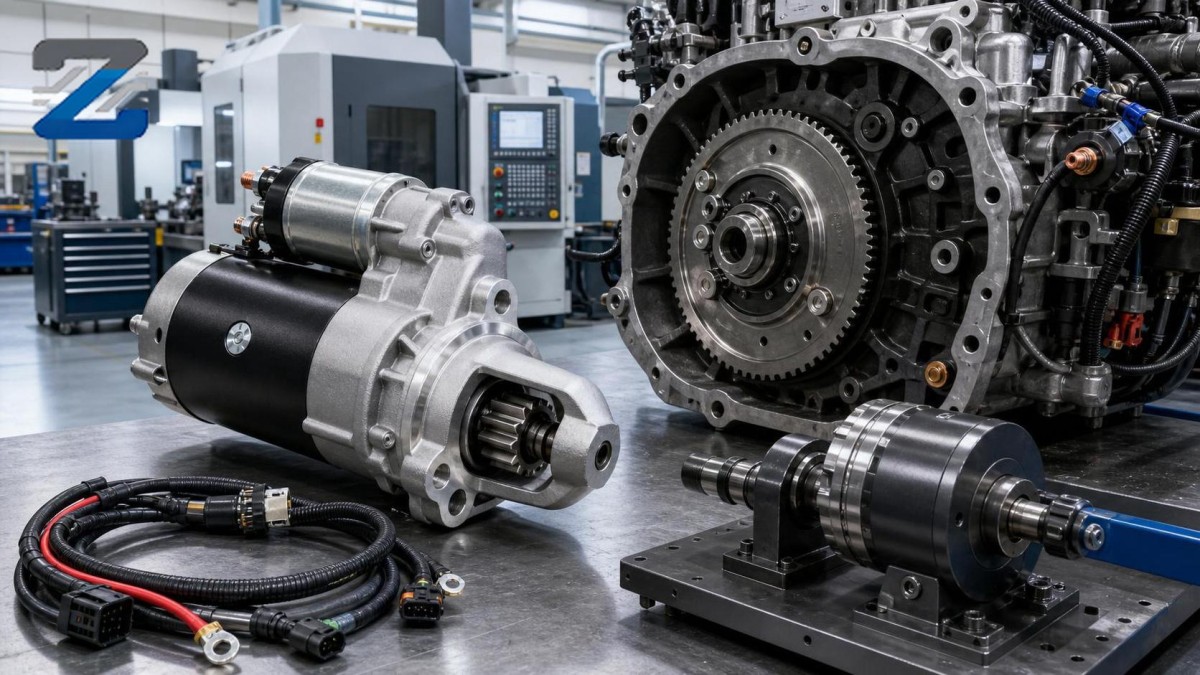
The core job of a heavy duty truck starter motor is simple: convert electrical energy into enough mechanical force to crank a large diesel engine reliably.
That sounds straightforward, but engine displacement, compression ratio, climate, and duty cycle all change what “enough” really means in daily operation.
This is why buyers often compare more than price. They need a unit that matches the vehicle platform and performs consistently under repeated starts.
Voltage sets the electrical foundation
Most heavy commercial vehicles use 24V systems, while some medium-duty platforms still use 12V. The starter motor must match the vehicle’s electrical architecture exactly.
A wrong voltage rating creates immediate risk. It can lead to weak cranking, overheating, damaged solenoids, or premature failure of the heavy duty truck starter motor.
Torque determines starting confidence
Torque output matters when engines face high compression, low ambient temperature, or frequent stop-start conditions. Higher torque improves cranking authority, especially in winter or on older engines.
Still, more torque is not always better by itself. It needs to align with engine requirements, ring gear engagement, and expected operating cycles.
Fitment is where many costly mistakes happen
Fitment goes beyond bolt pattern. It includes mounting position, pinion tooth count, rotation direction, flange type, overall dimensions, and terminal layout.
Even when two units look similar, a small difference can affect engagement depth or installation clearance. In practice, this is a common source of returns.
Why sourcing quality now requires deeper comparison
In the manufacturing and processing machinery supply chain, consistency matters as much as specifications. Stable materials, controlled machining, and repeatable winding quality affect actual field performance.
A supplier with integrated die-casting, CNC processing, winding, and assembly usually offers better process control. That reduces variation across batches and improves traceability for repeat orders.
Factories with mature model coverage also make cross-referencing easier. When more than 2,000 established starter motor models are available, replacement matching becomes faster and less uncertain.
Practical ways to compare options
A useful comparison process usually includes the following points:
- Confirm OE number, voltage, power rating, and rotation direction.
- Review torque needs against engine size and climate conditions.
- Check tooth count, flange details, and terminal position before ordering.
- Ask about production capacity, testing routines, and model maturity.
- Compare long-term supply stability, not only unit price.
For fleets serving trucks, construction machinery, and agricultural tractors, this method gives a clearer basis for choosing the right heavy duty truck starter motor.
A practical next step
The best starting point is a clean requirement list. Gather voltage, engine model, OE reference, mounting data, and operating environment before comparing suppliers.
With those details in hand, it becomes much easier to judge whether a heavy duty truck starter motor will deliver the fit, torque, and reliability needed for dependable service.